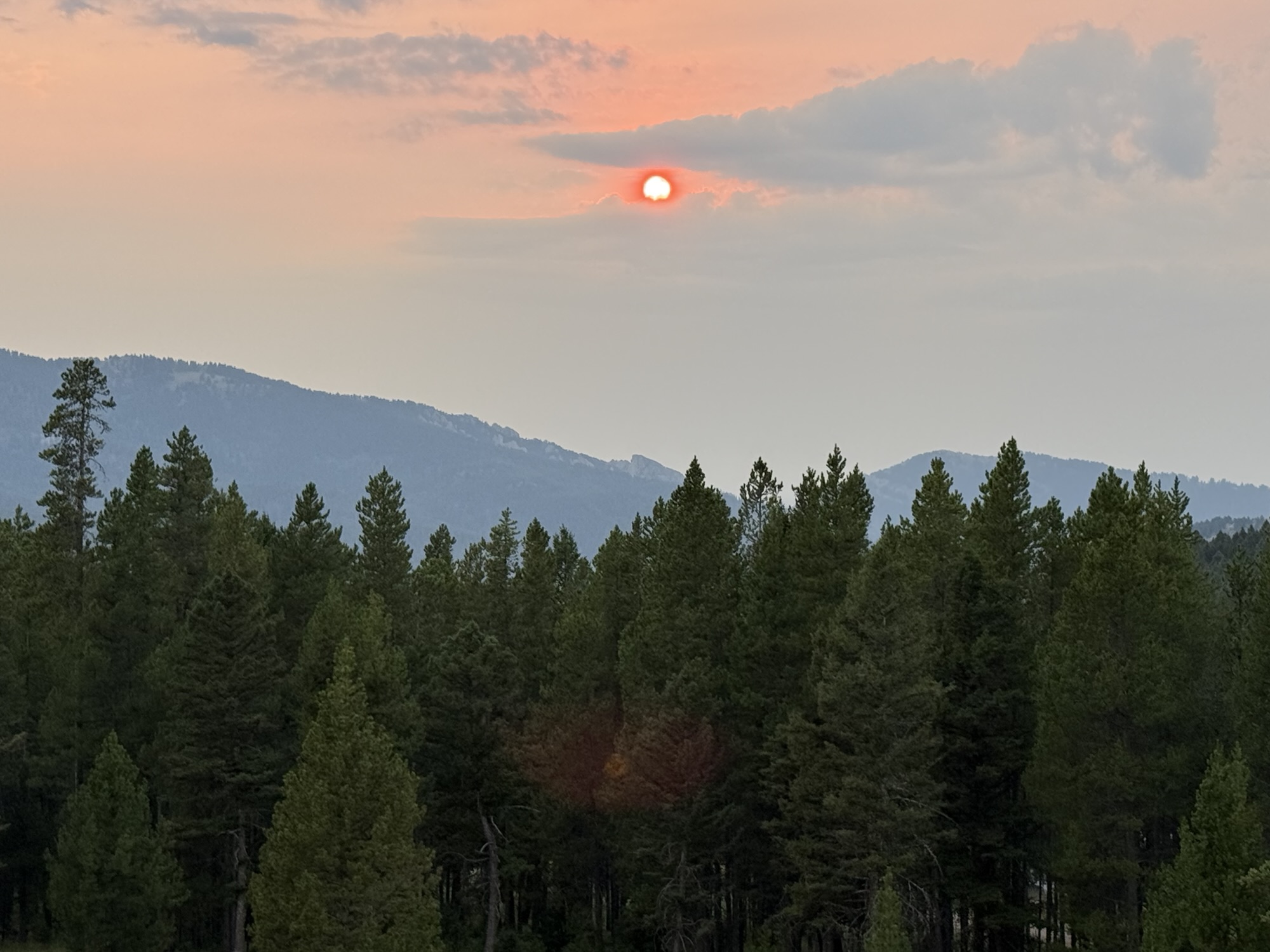
Living in the mountains of southwest Montana means getting used to conditions that change quickly and don’t always feel predictable. Some days are clear and sharp, with long views across ridgelines and valleys. Other days, especially in late summer, the air fills with smoke from wildfires burning somewhere in the region.
Lately, it’s been smoky.

The sun doesn’t look quite right when it rises. Instead of bright light, it comes through as a muted orange disk behind a thin but persistent haze. The mountains in the distance lose their detail and turn into soft outlines and often disappear entirely. Even the air itself feels different. Dry, warm, like a fever and carrying the faint smell of burning wood.

It’s not always easy to live with. The smoke is a constant reminder that somewhere out there, fires are active and moving through forests and open land. Even if they are far away, the wind makes them part of daily life here. With any lightning storm or human error, fire could happen here.
Still, the day continues.
Life in the mountains doesn’t stop just because the sky is hazy. People adjust. You check the wind direction more often. You notice when the smoke gets heavier or lighter. You learn to read the sky in a different way than you would in a place without fire season.
By evening, things usually start to shift.
The heat drops, and the light changes. Even with smoke in the air, sunset still manages to push through in muted colors, soft oranges, dull pinks, and a kind of filtered gold that spreads across the valley. The mountains briefly reappear in layers before fading again into shadow.
When night finally settles in, the smoke becomes less noticeable. The temperature cools enough to open all the windows, and the sounds of the land start to take over.
The wind often pick up and seems to have a presence of its own. You can hear it moving through the forest even when you can’t see it.
That’s when the crickets begin.
They are constant here in the summer. Not loud in a harsh way, but steady, coming from the grass, the edges of the woods and the meadows beyond the house. Once you notice them, it’s hard to stop hearing them. They fill in the quiet spaces that the wind leaves behind.
After a day of watching smoky skies and thinking about fires that are out of sight but never fully out of mind, the crickets feel grounding. They don’t react to any of it. They don’t change with the news or the weather reports. They just continue their rhythm as if nothing else exists.
From inside the house, with the windows open, their sound drifts in clearly. Every so often, the wind moves through the trees and shifts the pattern. A distant animal might call out once or twice, then go quiet again. And then the crickets return, steady as before.
It’s simple, but it works. It makes the house feel less isolated and the night feel less heavy.
Living in the mountains has a way of putting things in perspective. The landscape is large and indifferent, and it doesn’t adjust itself to your comfort. You learn quickly that you are part of something bigger and less controllable than daily routines or personal plans.

You adapt to it instead of expecting it to adapt to you.
Days start with the sun, even when it’s filtered through smoke. They end with the same cycle of cooling air and fading light, no matter what the sky looked like earlier.
And at night, there is always the same choice: close everything up or open all the windows and listen.
Most nights, the windows stay open.
The smoke may still hang over the valley. The fires may still burn somewhere beyond the ridges. The mountains may remain half-hidden in the distance.
But the crickets do not change.
They keep singing, small, steady, and certain, cutting through everything the sky refuses to make clear.
And in that contrast, sleep finally comes.

Leave a Reply